Uzbekistan · Khorezm
Khiva on foot through Itchan Kala as the day empties
A leisurely route through Khiva’s walled city to decide where to sleep, what to see slowly and how to arrive without turning the site into a race between monuments.
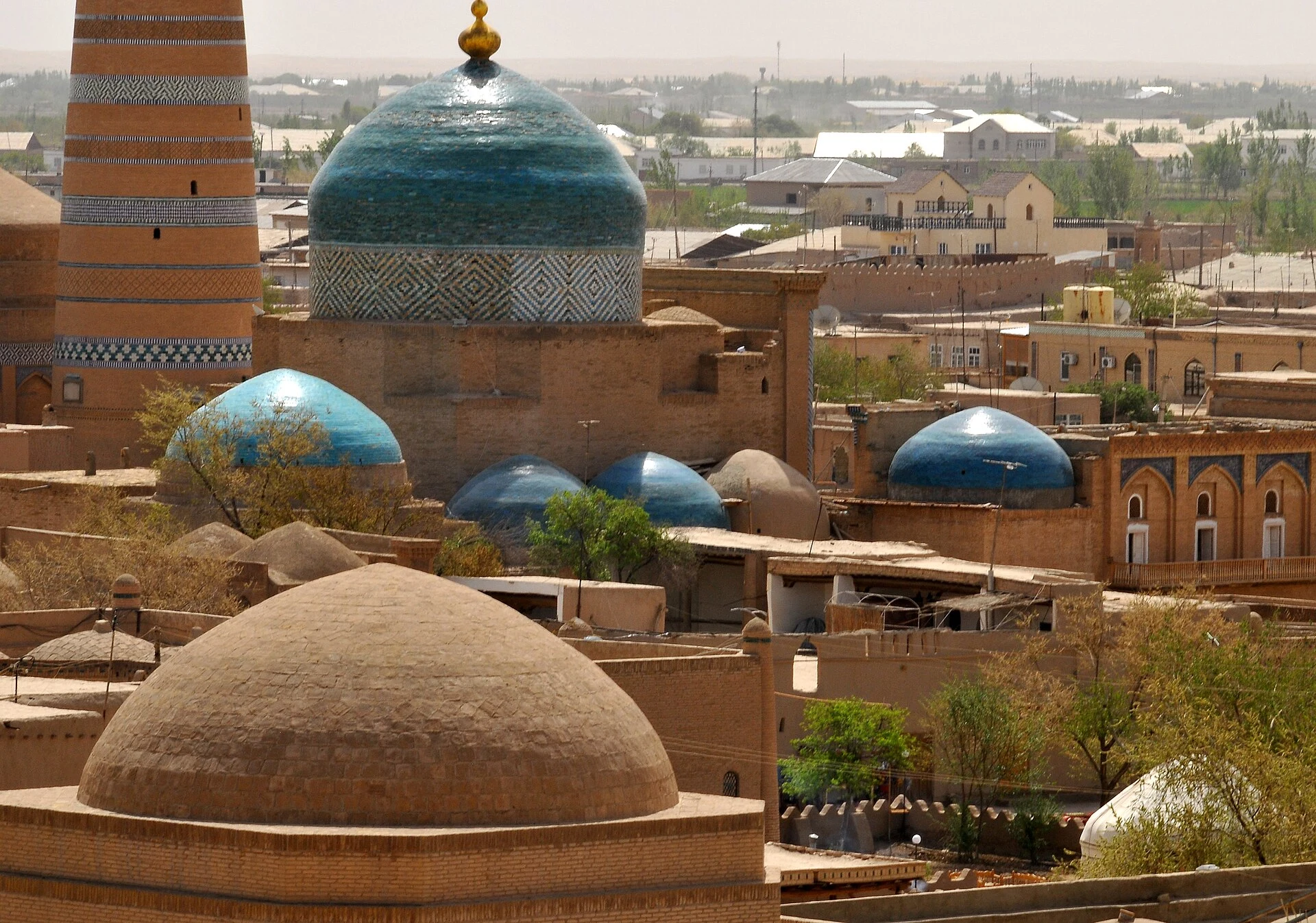
Itchan Kala, Khiva’s walled core, works best when visited as a living historic city, rather than as a backdrop for quick photographs. Its walls, mosques, madrasas, courtyards and homes form a compact whole, but the interest lies in comparing different scales: the dim interior of Juma Mosque, the spaces of power at Kunya Ark and Tash Hauli, and the streets where everyday life still unfolds. Arriving in the late afternoon and staying for at least one night lets you see the site before the daytime crowds gather and spread the visit out without forcing the pace.
Sleeping inside or outside the walls
The main practical decision is accommodation. Sleeping inside Itchan Kala makes it easy to head out early, return to rest during the hottest hours and walk along quieter streets after dark. In exchange, you should expect a historic setting: paving can be uneven, access routes may be narrow, and not every property will offer the same mobility conditions or luggage-transfer arrangements.
Staying outside the walls may make arrival by car easier and provide a wider choice of services, but it adds journeys that reduce flexibility early in the morning and late in the afternoon. For a first visit, one night inside—or immediately beside a gate—is a good compromise; two nights make sense if you want to visit museums, stop at workshops and leave one period free of plans.
Do not book based on photographs alone: ask about the actual walking distance, steps, the access surface and whether luggage can be left near the entrance.
A short route that leaves room to return
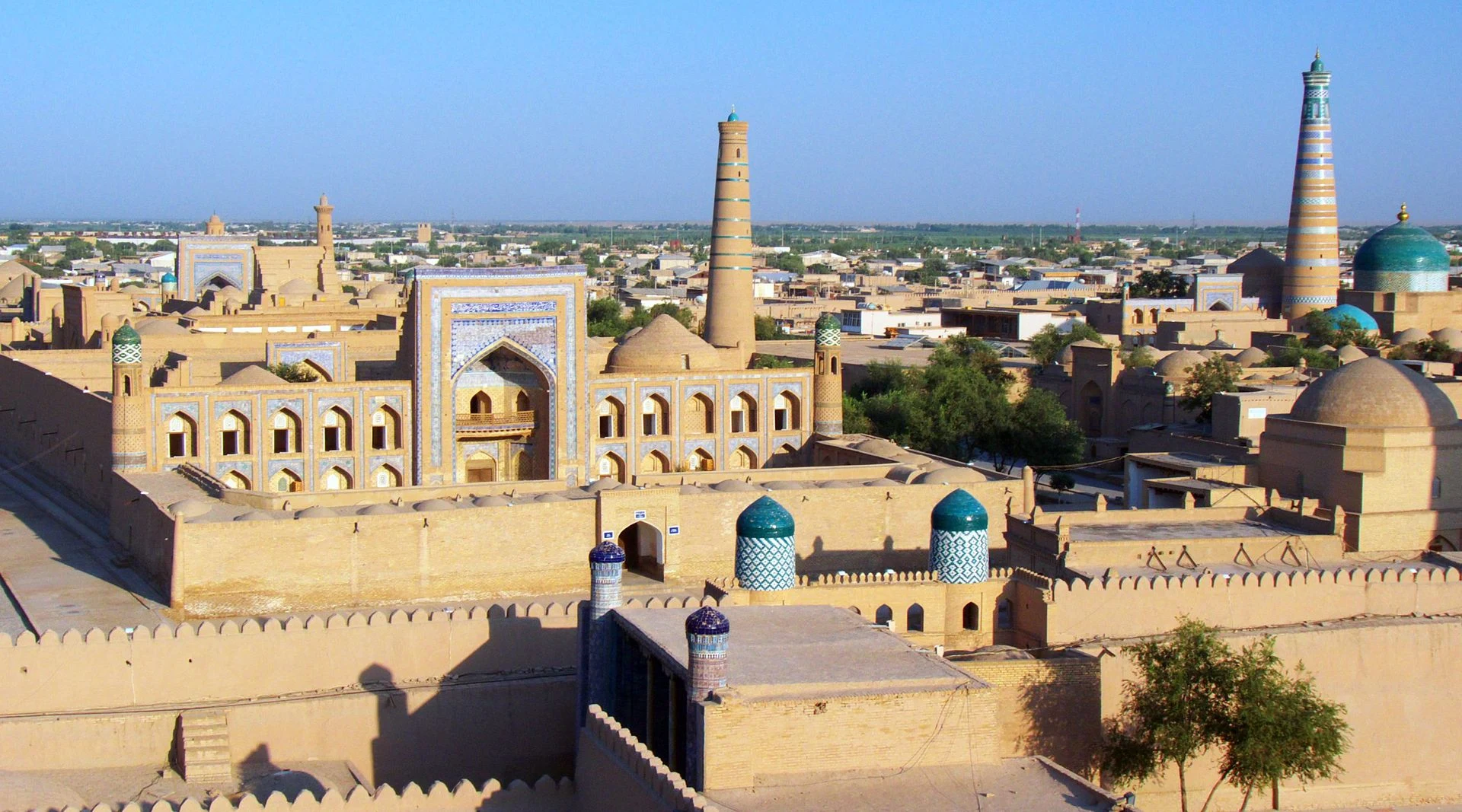
Itchan Kala measures approximately 650 by 400 metres: it is manageable on foot, but it should not be ticked off as though every building were an equivalent stop. Start at Ata Darvaza, the western gate, and enter Kunya Ark. The former citadel helps you understand the institutional scale of the khanate before you move on to the streets and courtyards within the enclosure.
Then set aside time for Juma Mosque. Its covered hall, supported by more than two hundred wooden columns, calls for slow walking and an adjustment to the low light; it is an essential counterpoint to the tiled façades. From there, continue east without chasing a perfectly straight line: the lanes reveal doorways, homes and small changes in shade.
Leave Tash Hauli for a second part of the day. Its courtyards help explain the differences between reception areas, palace life and interior circulation. The Islam Khoja complex can bring the route to a close with its minaret and madrasa. If an interior is closed, do not compensate by adding more stops: return to the wall or walk along a street again in different light.
Reaching Khiva without relying on a private car
Khiva appears as a destination in Uzbekistan’s official railway search system, so the train is an option worth checking when building a national itinerary. Availability, timetables, classes and advance-sale periods may change: check the journey and issue the ticket directly through the official railway system before deciding how many nights to book.
Urgench remains an important gateway to Khorezm. In August 2026, new railway infrastructure was announced to connect Urgench Airport with the network and with Khiva, but travellers should confirm that the service is actually operating, its frequency and the exact departure point before relying on it.
Once you are near Itchan Kala, the visit described here is essentially on foot. A one-off transfer on arrival or departure may be more sensible than hiring a car, especially if your aim is to focus on the walled enclosure.
Looking attentively at a living city
Itchan Kala’s heritage designation is not limited to individual monuments: it includes the urban composition, walls, markets, madrasas, mosques and domestic architecture. That changes the way you should explore it. Homes are not an extension of a museum or a set for portraits; keep your distance from private doorways and ask permission before photographing people or places where everyday activity is taking place.
At places of worship, wear clothing that allows you to cover your shoulders, back and legs if requested. It is also worth keeping your voice down and avoiding turning religious halls into hurried passageways. Respecting the place’s current use is as important as identifying its architectural features.
The conservation of Itchan Kala faces challenges linked to ground moisture, salinity and wooden structures. Do not climb onto walls, leave designated routes or rest tripods or luggage on fragile surfaces. These small gestures help ensure that visiting does not add pressure to a vulnerable site.
The time of day matters more than collecting admissions
Khiva’s climate is dry, with very hot summers and winters that can fall below freezing. Rather than planning one endless day, arrange two outings: one after the city opens and another in the late afternoon. The first helps with orientation, while the second lets you return to the gates, walls and courtyards when the heat and flow of groups are usually less intense.
Carry water, sun protection and sturdy footwear for the paving. If you travel in the colder months, add a warm layer: visits alternate between shaded interiors and exposed spaces. Do not base your plan on timetables published by third parties; museums, viewpoints, combination tickets and interior access should be confirmed close to the date with the museum-reserve or official tourism information.
Khiva rewards an incomplete itinerary. The aim is not to have entered every building, but to leave understanding how the courtyards, streets, religious institutions and defences form one city.
References to check before travelling
Heritage and conservation: the Itchan Kala profile and follow-up decisions from the UNESCO World Heritage Centre.
Local orientation and rules at religious sites: the official Uzbekistan Travel portal, with pages devoted to Khiva, Itchan Kala, Ata Darvaza, Kunya Ark and Islam Khoja.
Trains and tickets: the official search system of Oʻzbekiston Temir Yoʻllari; check the itinerary, availability and sale conditions for the exact date.
Urgench–Khiva connection: an infrastructure announcement by the Presidency of the Republic of Uzbekistan, published on 17 August 2026; confirm commercial operation before relying on it.
References consulted during editorial review. Times, requirements and advisories may change: always confirm with the official source.
- https://whc.unesco.org/en/list/543 whc.unesco.org
- https://whc.unesco.org/en/statesparties/uz whc.unesco.org
- https://whc.unesco.org/en/statesparties/uz/documents whc.unesco.org
- https://whc.unesco.org/en/list/543/documents whc.unesco.org
- https://whc.unesco.org/en/documents/110918 whc.unesco.org
- https://whc.unesco.org/archive/2016/whc16-40com-inf8B1-Add-en.pdf whc.unesco.org
- https://whc.unesco.org/document/183360 whc.unesco.org
- https://whc.unesco.org/en/decisions/9080/ whc.unesco.org
- Uzbekistán WikidataCC0 1.0 Wikidata · Q265
- Uzbekistan World Countries — mledozeODbL 1.0 World countries dataset by mledoze and contributors · ODbL 1.0
- Uzbekistan World Bank Open DataCC BY 4.0 World Bank
- Uzbekistan DBpediaCC BY-SA 3.0 DBpedia
- Urgench GeoNamesDatos geográficos bajo CC BY 4.0; requiere atribución a GeoNames. Fuente: GeoNames
- Urgench, Xorazm Region, 220100, Uzbekistan OpenStreetMapODbL 1.0; atribución y obligación de compartir bases derivadas. Fuente: OpenStreetMap
- Urgench, Xorazm Region, Uzbekistan OpenStreetMapODbL 1.0; atribución y obligación de compartir bases derivadas. Fuente: OpenStreetMap
- Urgench Airport OpenFlightsODbL 1.0 (base de datos) / DbCL 1.0 (contenidos) Urgench Airport · OpenFlights · ODbL 1.0