Equatorial Guinea · Bioko Island
Planning visits to Malabo Cathedral and Batete Church on Bioko
A brief visit linking Malabo Cathedral with Batete’s wooden church, while keeping sight of the logistical limits and living significance of both places.
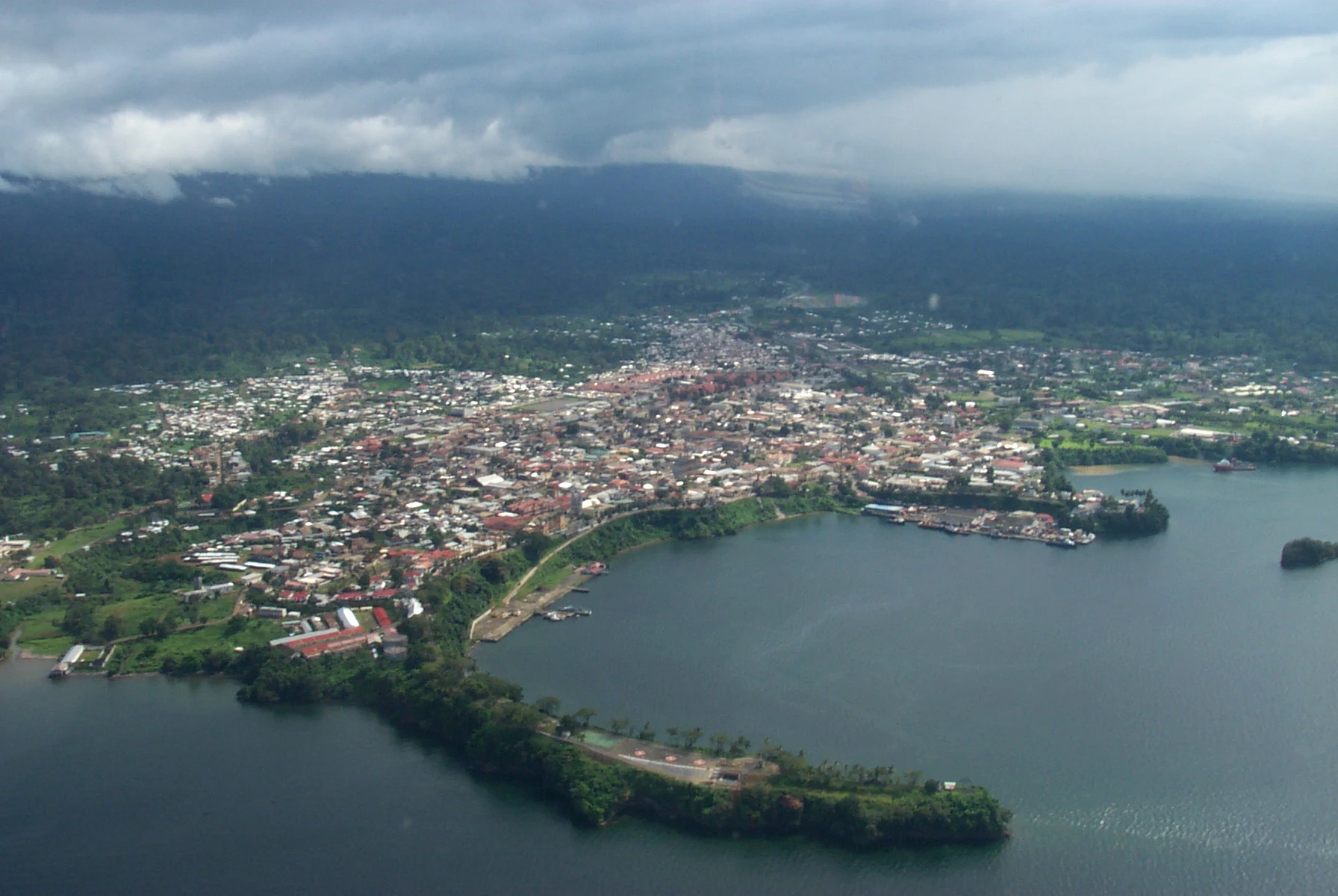
On Bioko, Malabo Cathedral and Batete Church offer two very different ways of translating Neo-Gothic architecture to a humid island in the Gulf of Guinea. The first organizes an urban square in the capital; the second stands in the south of the island and preserves an exceptional wooden structure. This is not a route to improvise: it requires confirmed local logistics and a careful reading of its missionary and community history.
Malabo: an urban landmark before leaving the capital
Malabo Cathedral, also known by its former name of Santa Isabel, is an early twentieth-century Neo-Gothic building recognizable by its towers and pink façade. It is best understood as part of the city rather than as an isolated monument: position yourself in the public space of the square, walk around the perimeter and observe how its proportions contrast with the low-rise fabric around it.
To enter, discreetly ask whether the church is open and whether a religious service is under way. Worship takes priority over visits. Avoid reducing the façade to a merely picturesque image: the building evokes the Spanish colonial presence and the local Catholic history, two layers that cannot be reduced to its architectural style.
Do not photograph airports, government buildings or military installations. If you are moving around Malabo with a camera, use sound judgment and ask permission whenever the situation is unclear.
Batete: wood, craftsmanship and vulnerability in southern Bioko
Batete’s Neo-Gothic church was built between 1922 and 1926 and stands out for an unusual feature: its structure is almost entirely made of tropical wood, worked into elements such as pointed arches, slender columns, vaults and stained glass. Its value lies not only in reproducing a European vocabulary; it also speaks of the work of local artisans trained in workshops associated with Banapá.
The church continues to serve a religious function and remains closely connected to the village. That continuity calls for a straightforward attitude: do not interrupt community activities, enter areas not open to the public or take interior photographs without asking first. Humidity, rain, wind, salinity and insects affect the building’s conservation; do not treat its fragility as an attraction.
Batete has been on UNESCO’s Tentative List since 14 April 2026. This means that the state has proposed it as a possible future nomination, but it does not amount to inscription as a World Heritage Site. Equatorial Guinea currently has no properties inscribed on that List either.
The journey between the two churches requires practical decisions
Do not frame Batete as an urban outing from Malabo. Public transport outside the main population centers is limited, and roadside checks are common. For a trip to southern Bioko, it is more sensible to arrange a vehicle and identifiable driver in advance through your accommodation, a reliable local contact or a tourist information office, travel during daylight and carry your passport or a valid copy when local regulations allow it.
Several risks affect the visit: consular advisories recommend not driving at night, warn of theft in taxis and note that emergency response may be limited. Carry enough cash as a backup without displaying it, but do not assume that ATMs, cards or connectivity will resolve an incident. Logistical independence matters more than adding stops.
Before booking, verify access to the church, road conditions, the possibility of an interior visit, the country’s entry requirements and any changes to security advice. These details vary and should not be inferred from tourism promotion.
A brief visit, not a race between landmarks
This combination works best if the aim is to compare materials and contexts: stone and city in Malabo; wood, the southern coast and community in Batete. Allow room for delays and accept that an interior visit may not be possible on the planned day. Flexibility is part of the itinerary, not a planning failure.
If a local authority, the community or the person responsible for the church says that it is not a good time to enter or take photographs, change your plan without insisting. Responsible travel is not about accumulating places, but about maintaining a visit that does not interfere with religious life or the building’s conservation needs.
Sources to check before travelling
- Equatorial Guinea’s Ministry of Tourism and Tourism Infrastructure: national tourism information, the Malabo Cathedral profile and guidance available at Malabo Airport.
- UNESCO World Heritage Centre: profile of Batete’s Neo-Gothic church, Equatorial Guinea’s Tentative List and inscription status.
- The United Kingdom’s Foreign, Commonwealth & Development Office: entry requirements, security, transport, payments and the state of emergency services.
- The United States Department of State: advisory level, health, crime risks and arbitrary enforcement of laws.
Consult these sources immediately before buying flights or finalizing transfers: visa and vaccination requirements, opening hours, access, road conditions and security advice may change.
References consulted during editorial review. Times, requirements and advisories may change: always confirm with the official source.
- https://whc.unesco.org/en/statesparties/gq whc.unesco.org
- https://www.gov.uk/foreign-travel-advice/equatorial-guinea www.gov.uk
- https://travel.state.gov/en/international-travel/travel-advisories/destination.gnq.html travel.state.gov
- https://travel.state.gov/en/international-travel/travel-advisories.html travel.state.gov
- https://whc.unesco.org/en/news/2340 whc.unesco.org
- https://www.gov.uk/foreign-travel-advice/equatorial-guinea/safety-and-security www.gov.uk
- https://whc.unesco.org/document/156800 whc.unesco.org
- https://www.gov.uk/foreign-travel-advice/equatorial-guinea/getting-help www.gov.uk
- Guinea Ecuatorial WikidataCC0 1.0 Wikidata · Q983
- Equatorial Guinea World Countries — mledozeODbL 1.0 World countries dataset by mledoze and contributors · ODbL 1.0
- Equatorial Guinea World Bank Open DataCC BY 4.0 World Bank
- Equatorial Guinea DBpediaCC BY-SA 3.0 DBpedia
- Corrupción y Derechos Humanos en Guinea Ecuatorial OpenAlexCC0 1.0 OpenAlex
- CIERRE GUINEA ECUATORIAL AFROHISPANA Y BANTÚ CrossrefMetadatos públicos; derechos específicos por campo cuando correspondan Crossref
- A PRENSA ESCOLAR EN GUINEA ECUATORIAL ENTRE LA HISTORIA Y LA CULTURA NACIONALES CrossrefMetadatos públicos; derechos específicos por campo cuando correspondan Crossref
- ÍNDICE CrossrefMetadatos públicos; derechos específicos por campo cuando correspondan Crossref
- INTRODUCCIÓN CrossrefMetadatos públicos; derechos específicos por campo cuando correspondan Crossref
- 8. AUTORIDAD LINGÜÍSTICA CrossrefMetadatos públicos; derechos específicos por campo cuando correspondan Crossref
- BIBLIOGRAFÍA CrossrefMetadatos públicos; derechos específicos por campo cuando correspondan Crossref
- Frontmatter CrossrefMetadatos públicos; derechos específicos por campo cuando correspondan Crossref
- CRONOLOGÍA CrossrefMetadatos públicos; derechos específicos por campo cuando correspondan Crossref
- Bioko, Bioko Sur, Región Insular, Equatorial Guinea OpenStreetMapODbL 1.0; atribución y obligación de compartir bases derivadas. Fuente: OpenStreetMap
- Malabo GeoNamesDatos geográficos bajo CC BY 4.0; requiere atribución a GeoNames. Fuente: GeoNames
- Malabo GeoNamesDatos geográficos bajo CC BY 4.0; requiere atribución a GeoNames. Fuente: GeoNames
- Malabo, Distrito de Malabo, Bioko Norte, Región Insular, Equatorial Guinea OpenStreetMapODbL 1.0; atribución y obligación de compartir bases derivadas. Fuente: OpenStreetMap
- Batete GeoNamesDatos geográficos bajo CC BY 4.0; requiere atribución a GeoNames. Fuente: GeoNames
- Batete GeoNamesDatos geográficos bajo CC BY 4.0; requiere atribución a GeoNames. Fuente: GeoNames
- Batete, Bioko Sur, Región Insular, Equatorial Guinea OpenStreetMapODbL 1.0; atribución y obligación de compartir bases derivadas. Fuente: OpenStreetMap
- Malabo Airport OpenFlightsODbL 1.0 (base de datos) / DbCL 1.0 (contenidos) Malabo Airport · OpenFlights · ODbL 1.0