Sudan · Kushite heritage
Kushite heritage in Meroe, Naqa and Musawwarat must wait
The pyramids, temples and enclosures of the Island of Meroe are essential to understanding the Kingdom of Kush. Sudan’s current situation means that a tourist visit must be postponed.
Meroe, Naqa and Musawwarat es-Sufra bring together a fundamental chapter in the history of the Nile Valley: cities, necropolises, sanctuaries and water systems linked to the Kingdom of Kush. But the first useful decision for anyone considering them is to postpone the trip. As of 16 September 2026, the armed conflict and the fragility of essential services make it impossible to plan a responsible tourist visit; the value of Kushite heritage does not justify taking risks or adding pressure to an emergency situation.
The practical decision: do not organise an archaeological route now
The three components lie outside Khartoum, in a stretch of desert and river valley whose logistics traditionally depended on road travel and local services. Today, those assumptions cannot be used to design an itinerary: official advisories discourage travel to Sudan because of the conflict, volatile security conditions and disruption to essential services.
A recent photograph, an isolated offer or the possible operation of an airport should not be interpreted as evidence that a viable tourist route exists. The situation can change without warning, while consular assistance and evacuation capacity are extremely limited. Do not book flights, guides or accommodation expecting to complete this visit in the short term; the priority must be to avoid turning a humanitarian crisis into a tourism opportunity.
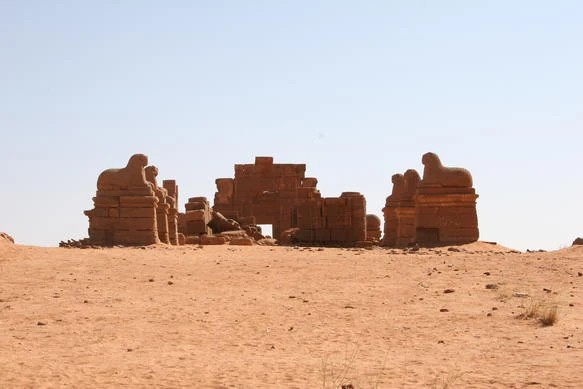
Three places that help situate the Kingdom of Kush
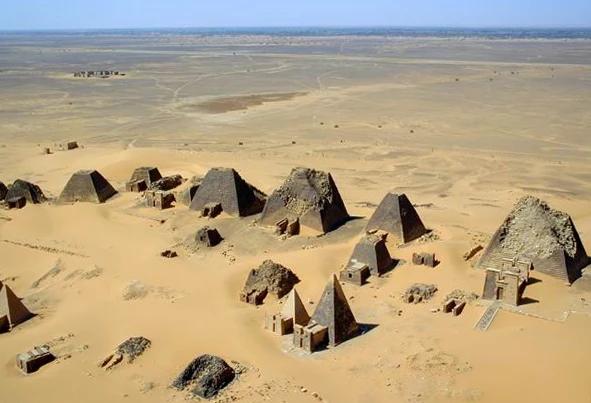
The so-called Island of Meroe is not a literal island: it is a historic region partly bounded by the Nile, the Atbara and the Blue Nile. The inscribed archaeological ensemble comprises Meroe, the capital and its funerary landscape; Naqa, a religious centre with temples; and Musawwarat es-Sufra, a large monumental complex inland.
Its significance extends well beyond the pyramids. The Kingdom of Kush was a regional power from the eighth century BC to the fourth century AD, maintaining long-standing connections with sub-Saharan Africa, the Mediterranean and the Near East. Its architecture, iconography, Meroitic inscriptions and evidence of iron production reveal exchanges, political decisions and religious practices without reducing Sudanese history to a mere appendix of Egypt.
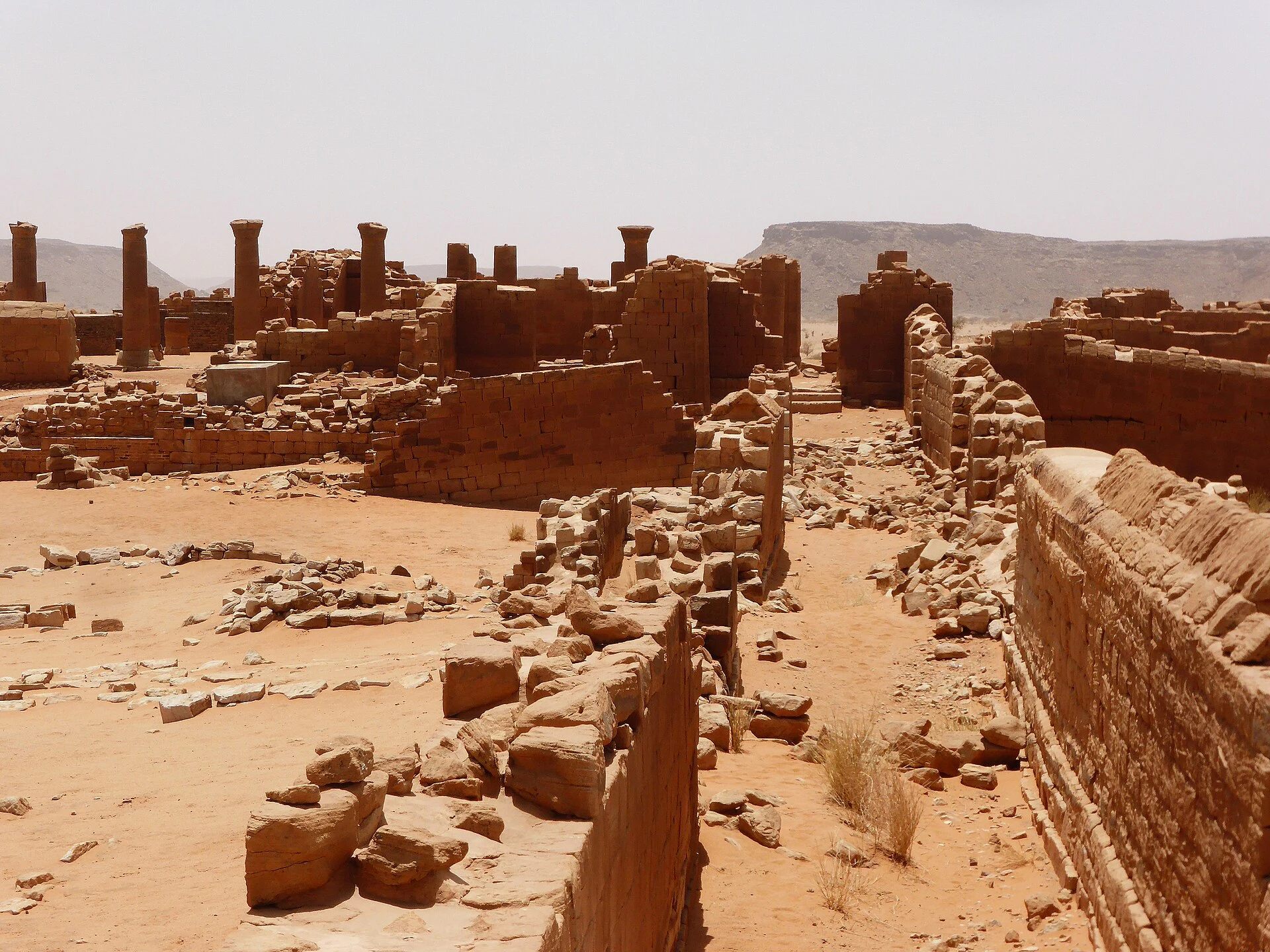
Meroe: necropolis, city and ironworking
At Meroe, the royal pyramids are the most recognisable visual feature, but they should be understood as part of a wider landscape. The tombs belonged to a capital with urban areas, ceremonial buildings and zones of productive activity. The presence of iron-related installations helps explain that Kushite wealth and state capacity did not depend solely on monumental burials.
This broader perspective matters for a future visit: a pyramid is a funerary monument, whereas the city and its material remains speak of social organisation, specialised labour and exchange networks. When access is safe again, time should be planned around understanding the site as a whole, not around a rushed photo stop.
Naqa and Musawwarat: temples, water and distinctive architectural forms
Naqa preserves temples and reliefs that display visual languages shared and reinterpreted within the Kushite world. Musawwarat es-Sufra, meanwhile, is notable for its large complex of courtyards, corridors and rooms, as well as structures associated with water management. In an arid environment, hafirs—artificial reservoirs—are an essential clue to understanding how life and ceremonial activity were sustained beyond the immediate riverbank.
Both sites invite us to avoid quick labels. Egyptian, Greco-Roman and local influences are present, but the result is Kushite architecture with agency of its own. Preparing with this idea in mind helps visitors avoid looking for copies of other Nile monuments and makes it possible to recognise the questions that remain open about the spaces’ uses, circulation and meaning.
Heritage at risk: why waiting is also a form of respect
The conflict primarily affects Sudan’s population, while also restricting the management, monitoring and conservation of archaeological sites. International heritage authorities have highlighted the vulnerability of the ensemble to war, flooding, climate change and a lack of resources for proper management.
For that reason, the responsible response is not to try to get there “before things change”, but to let local conditions determine the timing. Any future reopening to tourism should be assessed using verifiable information about security, transport operations, healthcare services, access conditions and the position of Sudan’s heritage authority. Until then, studying the Kingdom of Kush through museums, academic publications and digital collections is a coherent alternative.
References to check before any trip
- United States Department of State, Sudan travel advisory: Level 4, do not travel; issued 15 May 2026.
- Government of Canada, Sudan travel advice and advisories: avoid all travel; updated 9 September 2026.
- United Kingdom Foreign, Commonwealth & Development Office, Sudan travel advice: advises against all travel to most of the country because of the conflict; in force on 15 September 2026.
- UNESCO World Heritage Centre, entry and conservation decision for the Archaeological Sites of the Island of Meroe; 2026 decision concerning conflict and the site’s vulnerability.
References consulted during editorial review. Times, requirements and advisories may change: always confirm with the official source.
- https://whc.unesco.org/en/list/1336 whc.unesco.org
- https://whc.unesco.org/en/list/1336/documents whc.unesco.org
- https://whc.unesco.org/en/list/1336/maps/ whc.unesco.org
- https://whc.unesco.org/en/statesparties/sd whc.unesco.org
- https://whc.unesco.org/en/list/1336/gallery/ whc.unesco.org
- https://travel.state.gov/en/international-travel/travel-advisories/sudan.html travel.state.gov
- https://whc.unesco.org/document/168997 whc.unesco.org
- https://whc.unesco.org/en/activities/413 whc.unesco.org
- Sudán WikidataCC0 1.0 Wikidata · Q1049
- Sudán WikidataCC0 1.0 Wikidata · Q209703
- Sudan WikidataCC0 1.0 Wikidata · Q13097273
- Sudán WikidataCC0 1.0 Wikidata · Q19805029
- Sudan World Countries — mledozeODbL 1.0 World countries dataset by mledoze and contributors · ODbL 1.0
- Sudan World Bank Open DataCC BY 4.0 World Bank
- Sudan DBpediaCC BY-SA 3.0 DBpedia