Papua New Guinea · East New Britain
Rabaul and Kokopo: Understanding a Caldera That Reshaped Life
A visit to Rabaul and Kokopo calls for the 1994 eruption, wartime memory, and current security and volcanic conditions to be considered together.
Conditions described in the guide: confirm current requirements and access with the official source before travelling.
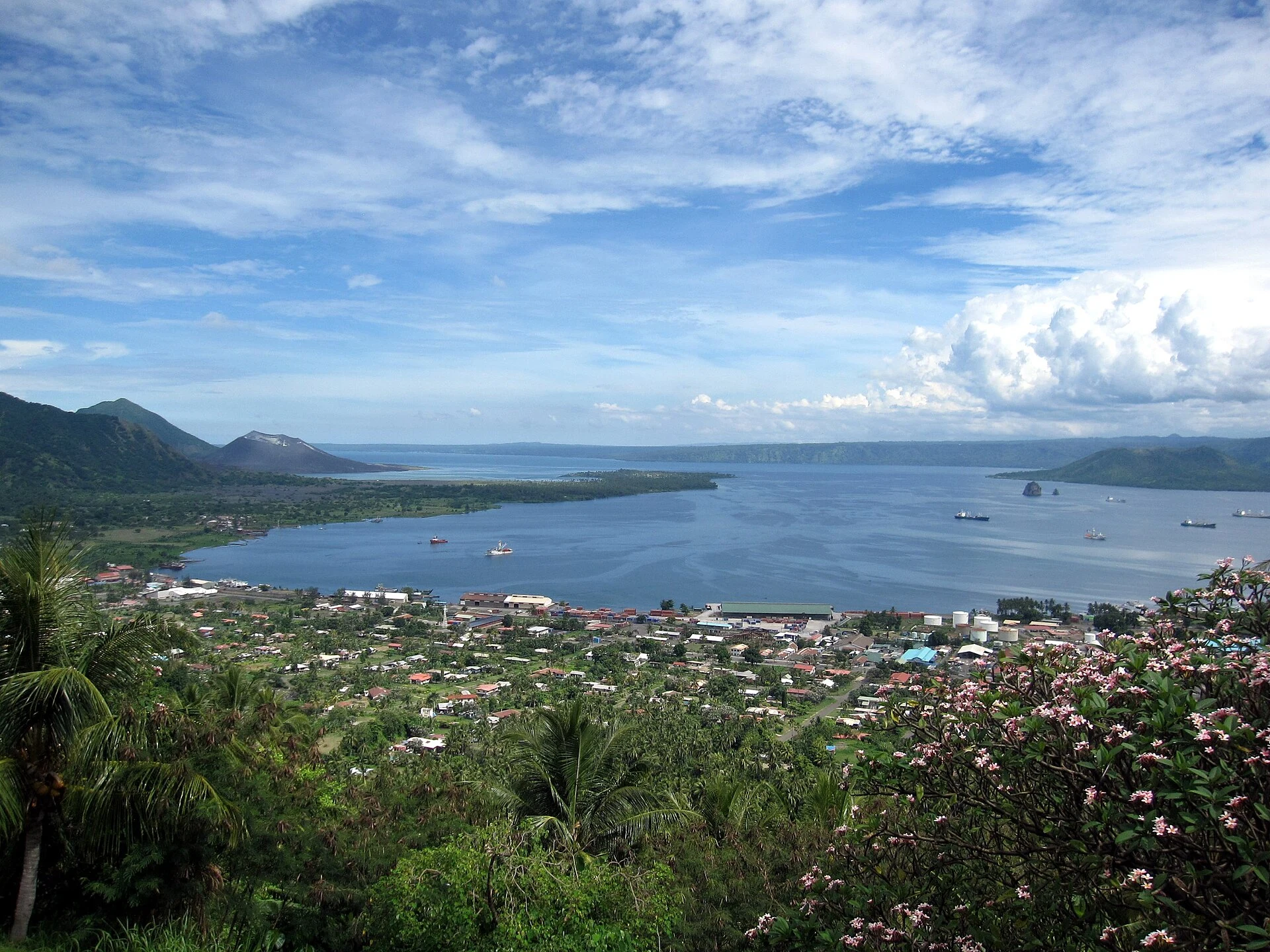
Rabaul and Kokopo are not interchangeable stops: they are two urban responses to the same active caldera. The 1994 eruptions of Tavurvur and Vulcan displaced people from Rabaul and moved many administrative functions to Kokopo. Travelling here meaningfully means understanding that transformation before seeking out viewpoints, tunnels, or beaches.
It also requires a prudent decision. As of 20 September 2026, official recommendations for Papua New Guinea describe serious and changing risks; for US travellers, the advice to reconsider travel remains in effect. No itinerary makes up for security, health, or volcanic-activity conditions that have changed.
Kokopo as a base, Rabaul as a lived landscape
It is advisable to stay in Kokopo, the provincial capital and the area around Tokua Airport, and reserve Rabaul for coordinated daytime visits. This choice does not treat Rabaul as an abandoned city: it helps explain how the 1994 eruptions changed housing, services, and the relationship between the two places.
Start at a high point overlooking Simpson Harbour and take in the scale of the caldera before approaching specific sites. Then explore Rabaul’s former centre with a guide, where ash, surviving buildings, and port activity tell a material story quite different from the standard volcanic postcard. Do not turn affected areas into disaster scenery: follow local instructions, stay out of restricted areas, and ask before photographing people or property.
A wartime memory that calls for context, not collecting
The Second World War left tunnels, bunkers, and other remnants in the area, but the experience gains depth by including Bita Paka War Cemetery. The cemetery contains graves and commemorations connected with the campaigns in New Britain and New Ireland during both world wars; it also includes stories of prisoners of war and troops from several territories.
The visit should be conducted soberly: speak quietly, respect the signs, and do not confuse a place of mourning with a themed attraction. Tunnels and military remains are not places to explore independently. In addition to the physical risks posed by deteriorating structures, unexploded ordnance remains a risk in Papua New Guinea away from established routes and known sites. Choose a guided visit that explains what you are seeing, who was affected, and what access is authorised that day.
Tavurvur is not an excursion that can be taken for granted
Tavurvur is an active cone on the edge of Simpson Harbour. The practical question is not whether a climb appears in an old itinerary, but whether access is possible and advisable on the exact date of your visit. The provincial tourism authority recommends confirming local conditions and using experienced guides; volcanic alerts must take precedence over any booking.
Treat the volcano as a flexible day out: first confirm conditions with the local operator and relevant authorities, then decide whether a viewpoint is sufficient, a guided route is available, or the plan should be replaced with Kokopo and its historic sites. Do not approach fumaroles, craters, or closed perimeters. Cancelling because of volcanic activity is a sound operational decision, not wasted time.
Logistics should reduce uncertainty, not add to it
Tokua is the airport serving Kokopo and Rabaul, but flight schedules, transfers, and availability can change. Confirm your flight directly with the airline and arrange a transfer before landing with accommodation or an identifiable provider. US official recommendations advise against using local taxis and public passenger vehicles; planning night travel or improvised walks is not sensible either.
Boat trips require additional caution. US authorities warn of piracy in the waters around Papua New Guinea, including the Bismarck Sea and the Solomon Sea. A trip to nearby islands should therefore be considered only after confirming the vessel, skipper, weather conditions, communications, and return arrangements with a reliable local provider. Do not base that decision on schedules published months ago.
When to postpone a trip to East New Britain
Reconsider or postpone the trip if you cannot arrange pre-booked transfers, a guide for excursions outside urban areas, a communications plan, and insurance or coverage that includes medical care and evacuation. Authorities cite violent crime, civil unrest, uneven healthcare outside the capital, and natural hazards among the national risks; these warnings do not automatically describe every moment in Kokopo or Rabaul, but they do establish the level of preparation required.
Before buying non-refundable flights, check the travel advice for your nationality again, along with health notices, Tavurvur’s status, and instructions from the local provider. Information current on the day of departure is more valuable than detailed planning made weeks in advance.
References to check before travelling
Consult these sources just before booking and again before departure:
- US Department of State: travel-advisory level for Papua New Guinea, security risks, ground transport, boating, health, and entry requirements applicable to US citizens.
- Government of Canada, travel advice for Papua New Guinea: national risk assessment and recent operational updates.
- Australian Government’s Smartraveller: security notices, local conflicts, service disruptions, and health advice.
- East New Britain Tourism Authority: access conditions for Tavurvur, local providers, and practical information about Bita Paka.
- East New Britain Provincial Government: context on the 1994 eruption and displacement from Rabaul.
- Papua New Guinea National Airports Corporation: operational information for Tokua Airport.
- Office of Australian War Graves / Anzac Portal: historical and commemorative context for Rabaul (Bita Paka) War Cemetery.
Verify any schedule, fare, access arrangement, flight, boat excursion, immigration requirement, or security notice with these organisations: such information changes and should not be assumed to be guaranteed.
References consulted during editorial review. Times, requirements and advisories may change: always confirm with the official source.
- https://travel.state.gov/content/travel/en/traveladvisories/traveladvisories/papua-new-guinea-travel-advisory.html travel.state.gov
- https://travel.state.gov/content/travel/en/international-travel/International-Travel-Country-Information-Pages/PapuaNewGuinea.html travel.state.gov
- https://travel.state.gov/en/international-travel/travel-advisories.html travel.state.gov
- https://www.gov.uk/foreign-travel-advice/papua-new-guinea www.gov.uk
- https://childabduction.state.gov/en/international-travel/travel-advisories.html childabduction.state.gov
- https://travel.gc.ca/destinations/papua-new-guinea travel.gc.ca
- https://www.smartraveller.gov.au/vi/node/245 www.smartraveller.gov.au
- https://2021-2025.state.gov/countries-areas/papua-new-guinea/ 2021-2025.state.gov
- Papúa Nueva Guinea WikidataCC0 1.0 Wikidata · Q691
- Papua New Guinea World Countries — mledozeODbL 1.0 World countries dataset by mledoze and contributors · ODbL 1.0
- Papua New Guinea World Bank Open DataCC BY 4.0 World Bank
- Papua New Guinea DBpediaCC BY-SA 3.0 DBpedia
- Un día luchando contra enfermedades tropicales en Papúa Nueva Guinea CrossrefMetadatos públicos; derechos específicos por campo cuando correspondan Crossref
- Una nueva especie de Tiarodes de Papúa-Nueva Guinea : T. melici n. sp. (Heteroptera, Reduviidae) CrossrefMetadatos públicos; derechos específicos por campo cuando correspondan Crossref
- Covid-19: ¿Por qué casi todos los habitantes de Papúa Nueva Guinea tienen pavor a las vacunas? CrossrefMetadatos públicos; derechos específicos por campo cuando correspondan Crossref
- El estatus del tío materno entre los ankave-anga: iniciaciones masculinas, ciclos de vida, género y parentesco en papúa nueva-guinea CrossrefMetadatos públicos; derechos específicos por campo cuando correspondan Crossref
- Rabaul GeoNamesDatos geográficos bajo CC BY 4.0; requiere atribución a GeoNames. Fuente: GeoNames
- Rabaul GeoNamesDatos geográficos bajo CC BY 4.0; requiere atribución a GeoNames. Fuente: GeoNames
- Rabaul, Rabaul District, East New Britain, Islands Region, Papua New Guinea OpenStreetMapODbL 1.0; atribución y obligación de compartir bases derivadas. Fuente: OpenStreetMap
- Tavurvur, Rabaul, Rabaul District, East New Britain, Islands Region, Papua New Guinea OpenStreetMapODbL 1.0; atribución y obligación de compartir bases derivadas. Fuente: OpenStreetMap
- Simpson Harbour GeoNamesDatos geográficos bajo CC BY 4.0; requiere atribución a GeoNames. Fuente: GeoNames
- Simpson Harbour, Rabaul, East New Britain, Islands Region, Papua New Guinea OpenStreetMapODbL 1.0; atribución y obligación de compartir bases derivadas. Fuente: OpenStreetMap