El Salvador · La Libertad
Joya de Cerén and San Andrés reveal two sides of Zapotitán Valley
Two archaeological parks, five kilometres apart, take visitors from Maya domestic life to the architecture of power in the Zapotitán Valley.
Conditions described in the guide: confirm current requirements and access with the official source before travelling.
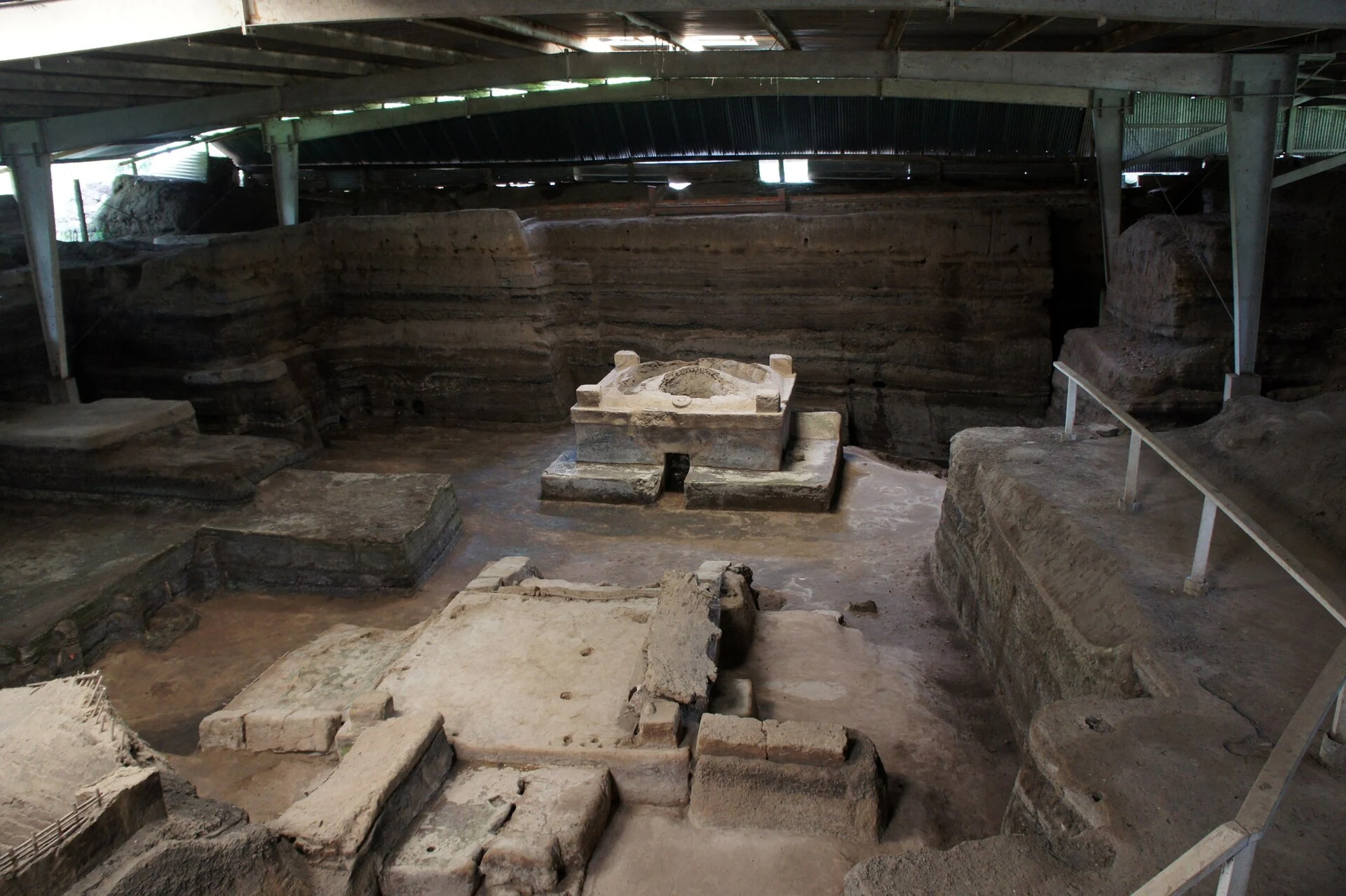
A short distance from San Salvador, Joya de Cerén and San Andrés offer an unusual archaeological experience: the point is not to collect ruins, but to compare an agricultural village preserved by volcanic ash with a monumental centre with restricted access. Visiting them in that order helps reveal how homes, crops, collective labour and political hierarchy shared the Zapotitán Valley.
The key is to set the right expectations: Joya de Cerén rewards slow observation of domestic details beneath protective shelters; San Andrés provides the scale of plazas and acropolises. Together, they offer two complementary readings of a landscape whose earthen heritage calls for an attentive and respectful visit.
Joya de Cerén begins at the scale of a home
Joya de Cerén was a pre-Hispanic agricultural community covered by the eruption of Loma Caldera in the seventh century. The ash preserved earthen buildings and organic materials that rarely survive in tropical climates: houses, storage areas, a kitchen, a steam bath, everyday objects and cultivated spaces.
Arrive with a simple question in mind: what was needed to sustain a household? Rather than looking for a large pyramid, observe the relationship between the buildings, storage areas and open spaces. Archaeobotanical research has documented household gardens and diverse crops, so the plant landscape is part of the explanation, not merely a backdrop for the structures.
The site is especially vulnerable because much of its value lies in the preservation of earthen architecture and fragile evidence. Always follow the designated routes, and use the explanations provided by staff or your guide to distinguish what is visible from what has been interpreted.
San Andrés broadens the view towards the plaza and acropolis
Around five kilometres away, San Andrés changes the scale. Its acropolis brings together structures raised with adobe and associated with restricted activities, probably linked to the ruling elite; a Great Plaza extends to the north, with the structure known as La Campana standing out.
The comparison does not require imagining that the two places were identical. San Andrés records occupation from the Middle Preclassic and reached its peak in the Late Classic, while Joya de Cerén offers an exceptionally precise snapshot of domestic life before the eruption. One makes organised power visible; the other, the work that organises everyday life.
At San Andrés, pause to notice changes in elevation, the boundaries between plaza and acropolis, and the building materials. The guided tour announced by the park lasts between 35 and 45 minutes; it can help place the structures before you mentally return to Joya de Cerén and connect the two records.
Plan the day as two visits, not a quick stop
Both parks lie in the Zapotitán Valley, beside the Pan-American Highway corridor, and institutional information places Joya de Cerén around 36 kilometres northwest of San Salvador. The sites are close enough to plan the same half-day, but do not assume that there is a convenient pedestrian connection or suitable public transport link between their entrances.
A sensible sequence is to begin at Joya de Cerén, when you have more attention available for its details, and continue to San Andrés, ending with the urban and ceremonial perspective. Arrange your private transfer, taxi or driver in advance, and agree on the return journey as well: the short distance between the parks is no substitute for clear logistics.
Opening hours, fees, group capacity, guide availability and possible closures are subject to change. Before setting out, confirm them directly in the Ministry of Culture listings included at the end; this article does not claim that a booking is required, because the information consulted indicates a capacity limit at San Andrés but does not establish a general booking requirement.
A responsible visit protects the less spectacular side
At Joya de Cerén, what matters is not only what you can see: the features preserved by the ash also matter, as do the shelters, research and maintenance efforts that aim to protect them. At both parks, stay on the designated routes, do not lean objects or your hands against walls or slopes, and follow the site team’s instructions.
The contrast between the two places helps avoid a narrow reading of Mesoamerican archaeology. Monumental plazas do not tell the whole history of the valley: the crops, storage areas, kitchen and meeting spaces of an agricultural community are equally necessary to understand it.
If you have time for only one, choose Joya de Cerén for a visit focused on everyday life and exceptional preservation; choose San Andrés if you are mainly interested in the layout of an acropolis and a Great Plaza. If you can visit both, keep the comparison open: they are different kinds of evidence, not interchangeable versions of the past.
References to check before your visit
Visitor and location information: Joya de Cerén Archaeological Park listing, Ministry of Culture of El Salvador. Check opening hours, fees, guides and any changes on the day of your visit.
Visitor information, tours and capacity: San Andrés Archaeological Park listing, Ministry of Culture of El Salvador. Pay particular attention to how guided groups operate.
Heritage context and conservation: Joya de Cerén dossier at the UNESCO World Heritage Centre.
Researched agricultural landscape: Slotten, Lentz and Sheets, study on landscape management and polyculture at Joya de Cerén, published in Journal of Anthropological Archaeology.
References consulted during editorial review. Times, requirements and advisories may change: always confirm with the official source.
- https://whc.unesco.org/en/list/675 whc.unesco.org
- https://www.cultura.gob.sv/parque-arqueologico-joya-de-ceren/ www.cultura.gob.sv
- https://whc.unesco.org/en/list/675/documents whc.unesco.org
- https://whc.unesco.org/en/list/0675/maps/ whc.unesco.org
- https://www.cultura.gob.sv/parque-arqueologico-san-andres/ www.cultura.gob.sv
- https://www.mitur.gob.sv/cinco-destinos-imperdibles-en-estas-vacaciones-agostinas/ www.mitur.gob.sv
- https://whc.unesco.org/en/statesparties/sv whc.unesco.org
- https://whc.unesco.org/en/activities/751 whc.unesco.org
- El Salvador WikidataCC0 1.0 Wikidata · Q792
- El Salvador WikidataCC0 1.0 Wikidata · Q195686
- El Salvador WikidataCC0 1.0 Wikidata · Q20221026
- El Salvador World Countries — mledozeODbL 1.0 World countries dataset by mledoze and contributors · ODbL 1.0
- El Salvador World Bank Open DataCC BY 4.0 World Bank
- El Salvador DBpediaCC BY-SA 3.0 DBpedia
- Sostenibilidad de las familias en los entornos de humedales de agua dulce del occidente de El Salvador CrossrefMetadatos públicos; derechos específicos por campo cuando correspondan Crossref
- Discontinuidades y limitaciones de los últimos planes turísticos de España en relación a la sostenibilidad ambiental del turismo de sol y playa CrossrefMetadatos públicos; derechos específicos por campo cuando correspondan Crossref