Saudi Arabia · heritage and planning
Two Days in AlUla for Hegra, Dadan and Jabal Ikmah
A two-day itinerary to distinguish Hegra’s Nabataean tombs, Jabal Ikmah’s inscriptions and the adobe fabric of AlUla’s Old Town.
Conditions described in the guide: confirm current requirements and access with the official source before travelling.
AlUla is best understood as a succession of oases, writing systems and architecture, rather than as a single desert excursion. Booking two separate days lets you devote one to Hegra and another to Dadan and Jabal Ikmah, leaving the Old Town for an evening stroll. The practical detail matters: the major archaeological sites are visited through organised circuits, so transport logistics shape the plan more than distances on the map.
Three places, three historical periods
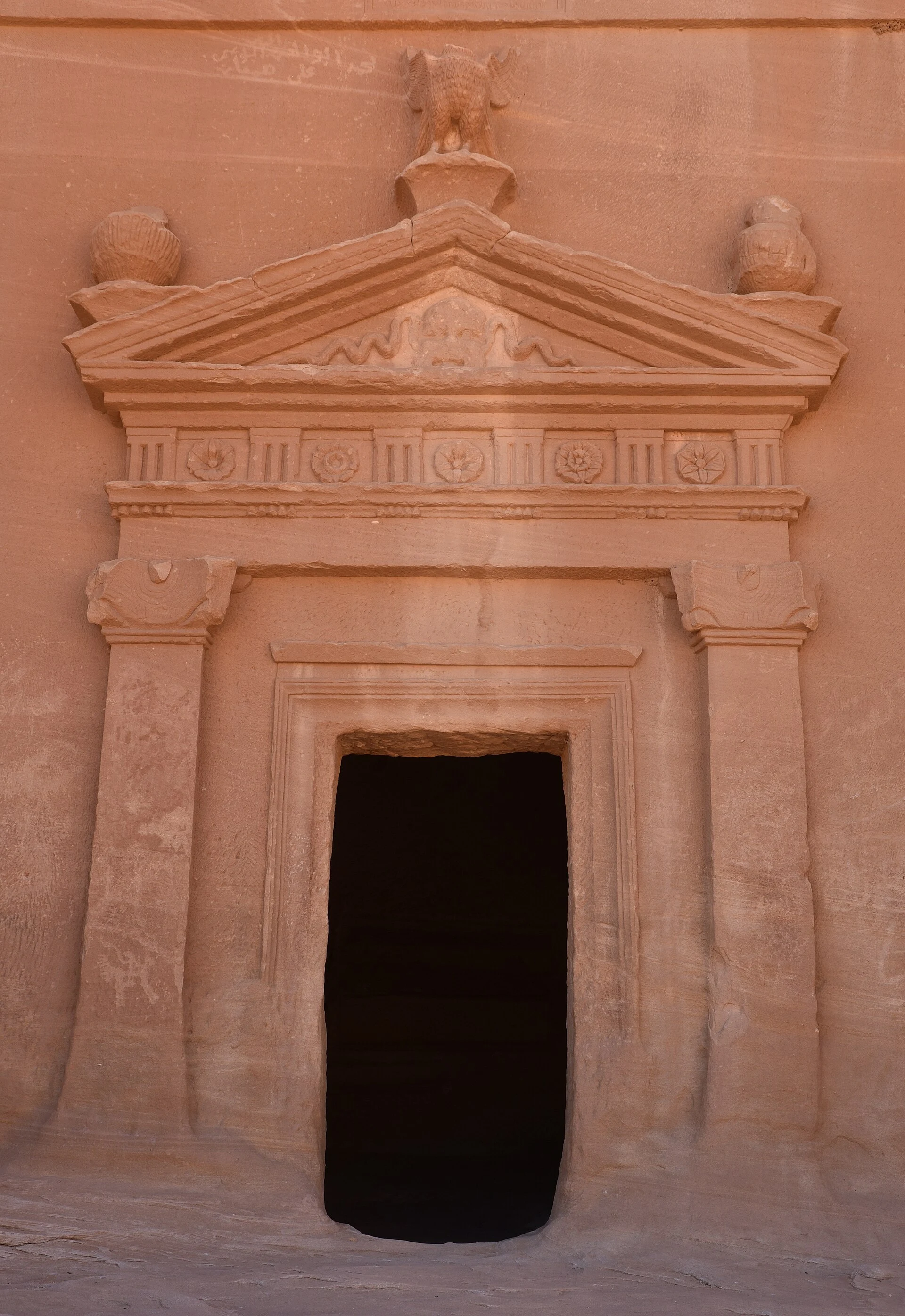
Hegra brings together the funerary façades carved by the Nabataeans and their water systems. It is the place to observe a monumental caravan city and the techniques that made an arid landscape habitable. Its scale and spread make it worth treating as a visit in its own right, rather than a quick stop.
Dadan offers a different perspective. It was the capital of the kingdoms of Dadan and Lihyan, which predated the Nabataean presence in the area. Here, pay attention to the archaeological site, the tombs carved into the hillside and the archaeological exhibition connected with the visit. Together, they help link the visible ruins with daily life, trade and ritual practices.
Jabal Ikmah completes the sequence as an open-air archive: the canyon preserves inscriptions and petroglyphs referring to names, offerings, activities and movements. It is not a museum of isolated objects; its interest lies in viewing the texts within the rocky landscape where they were carved. Hegra, Dadan and Jabal Ikmah are not interchangeable: they represent different periods and ways of inhabiting the oasis.
Day one: Hegra without packing in too many stops
Give the whole morning or afternoon to Hegra. The visit follows an organised route with a vehicle and designated stops, making it possible to cover an extensive area without turning the day into a long walk under the sun. Follow the marked paths, do not enter tombs or restricted areas, and avoid touching carvings or inscriptions; preservation also depends on keeping visitor traffic within prepared areas.
The best counterpoint afterwards is AlUla Old Town. Its adobe passageways, gates and fortifications speak of a much more recent settlement, linked to trade and exchange routes and to the pilgrimage route to Mecca. Exploring it at the end of the afternoon ensures that the day is not limited to monumental archaeology.
Do not try to fit Hegra, Dadan and Jabal Ikmah into a single morning. Even when transport within each circuit is arranged, check-in, waiting, boarding and transfers to the departure point make a two-day plan more realistic.
Day two: Dadan and Jabal Ikmah as a single visit
Dadan and Jabal Ikmah are organised together from Winter Park, with transport included to the heritage area. You can choose an option with a local guide’s narration or a route with an audio guide and operational assistance. The first encourages questions and historical connections; the second works well if you prefer to pause more independently at particular writing panels.
Start with Dadan to establish the political and urban framework before reaching Jabal Ikmah. At the site, keep one simple idea in mind: an oasis was not merely a place for cultivation, but also infrastructure for movement, power and ritual. Then, at Jabal Ikmah, slow down. Inscriptions require more attention than a façade: compare sizes, locations and languages without assuming that every mark is decorative.
The visit involves low-intensity walks, but the operator states that it is not suitable for wheelchair users or pushchairs. Anyone needing an accessible alternative should check the conditions of each experience before purchasing a ticket.
The key decision: where to stay and how to reach the departure point
AlUla is not a compact town centre from which every archaeological site can be reached on foot. The Old Town and AlJadidah are good areas for walking, eating and ending the day, but Hegra, Dadan and Jabal Ikmah require specific transfers. Choose your accommodation according to your priority: being close to evening urban life or shortening the journey to Winter Park and the archaeological sites.
For Hegra and for Dadan with Jabal Ikmah, do not plan to drive to each monument. Regular visits use coaches departing from designated points; hiring a car can be useful for getting to your accommodation and for journeys not covered by the circuits, but it does not replace heritage-circuit transport. Urban public transport and on-demand services are also available, although their practical coverage for a particular booking should be checked before relying on them.
Bring a reusable water bottle, sun protection, closed shoes and a layer for cooler weather. These are small decisions, but they reduce the need for last-minute purchases and make outdoor waiting times easier to manage.
Bookings, pace and a considerate visit
The availability of visits, meeting points, languages, schedules and change policies may vary according to the date, weather, visibility and cultural programme. Book in advance if your itinerary depends on a particular time slot, but review the current conditions just before setting out: in some cases, same-day sales may be available subject to availability.
Prioritise visits that explain the site over accumulating photo stops. At Jabal Ikmah and Hegra, do not remove stones, sand or fragments; do not make new inscriptions; and ask permission before photographing people. In the Old Town, the streets are also a space for local activity, not merely a heritage backdrop.
The result is a more precise journey: one day for the Nabataean city and another for the kingdoms, texts and oases that preceded and surrounded it.
References to check before travelling
- Experience AlUla: confirm tickets, schedules, the Winter Park meeting point, guided or audio-guide options, mobility requirements and weather-related changes for Hegra, Dadan and Jabal Ikmah.
- Royal Commission for AlUla: review official planning and transport information within the destination, as well as updates from the heritage sites.
- UNESCO World Heritage: consult the context and significance of Hegra as an inscribed site.
- UNESCO Memory of the World: consult the entry on Jabal Ikmah’s inscribed stone chronicles and the documentary scope of its inscriptions.
- Saudi Tourism Authority: verify entry requirements, connections and national recommendations applicable to your passport and travel dates.
Operational details should be checked in the sources above before booking, especially if you are travelling after 22 September 2026.
References consulted during editorial review. Times, requirements and advisories may change: always confirm with the official source.
- https://whc.unesco.org/en/list/1293 whc.unesco.org
- https://whc.unesco.org/en/statesparties/sa whc.unesco.org
- https://whc.unesco.org/document/152272 whc.unesco.org
- https://whc.unesco.org/en/list/1293/maps whc.unesco.org
- https://www.experiencealula.com/en/places-to-go/alula-old-town www.experiencealula.com
- https://whc.unesco.org/document/168945 whc.unesco.org
- https://www.visitsaudi.com/en/destinations/alula?lang=en www.visitsaudi.com
- https://whc.unesco.org/document/168942 whc.unesco.org
- Arabia Saudí WikidataCC0 1.0 Wikidata · Q851
- Saudi Arabia World Countries — mledozeODbL 1.0 World countries dataset by mledoze and contributors · ODbL 1.0
- Saudi Arabia World Bank Open DataCC BY 4.0 World Bank
- Saudi Arabia DBpediaCC BY-SA 3.0 DBpedia
- Arabia Saudí y las dinámicas de financiarización en Oriente Medio: algunas repercusiones geopolíticas del proyecto Neom en el Mar Rojo OpenAlexCC0 1.0 OpenAlex
- La proyección internacional de Arabia Saudí: poder sutil en Oriente Medio OpenAlexCC0 1.0 OpenAlex
- Arabia Saudí: Un coloso con los pies de barro OpenAlexCC0 1.0 OpenAlex
- La comunicación visual en la proyección internacional de Arabia Saudí: la visión 2030 OpenAlexCC0 1.0 OpenAlex
- Arabia Saudí: coronavirus, tronos y guerra petrolera CrossrefMetadatos públicos; derechos específicos por campo cuando correspondan Crossref
- Jabal Ikmah, 375, Al Shiraeia, Al Ula, Medina Province, 43563, Saudi Arabia OpenStreetMapODbL 1.0; atribución y obligación de compartir bases derivadas. Fuente: OpenStreetMap