Cambodia · Archaeological heritage
Koh Ker, a Khmer capital to explore at your own pace and with transport
Koh Ker is not a single-temple visit: it is a former dispersed capital, with a central pyramid, outlying sanctuaries and a circuit that requires transport planning.
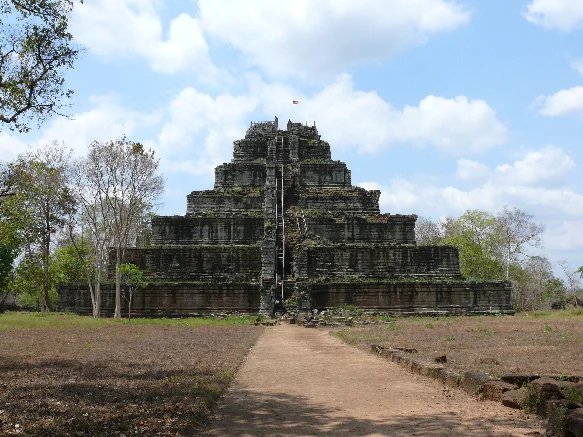
Koh Ker rewards visitors who approach it as an extensive ritual city, not as a photo stop beside a pyramid. This capital of the Khmer Empire, active for much of the first half of the 10th century, brings together temples, reservoirs, inscriptions and traces of urban planning in a wooded landscape in northern Cambodia. The key decision is simple: book a day with transport available throughout the visit and accept that carefully selecting a few groups is more worthwhile than trying to cover everything.
The pyramid is the landmark, but the city explains Koh Ker
Koh Ker was founded by Jayavarman IV in 921 and served as the Khmer capital until 944; between 928 and 944, it was the empire’s only capital. Its importance is not limited to Prasat Prang, the stepped pyramidal structure standing about 35 metres high: the site preserves the logic of a capital built in a brief phase, with sanctuaries, sculptures, inscriptions and hydraulic works.
It is worth beginning at this scale. The inscribed area covers more than 1,000 hectares, and the layout of the ancient city remains perceptible. The great Rahal reservoir, monumental axes and use of monolithic blocks reveal a specific political ambition: to create a royal seat distinct from Angkor and make it visible in stone. In this context, a linga is not a decorative detail; it forms part of the religious and territorial language that organised the site.
The visit becomes more rewarding when you look for the relationship between water, platforms, enclosures and forest instead of chasing a list of isolated towers.
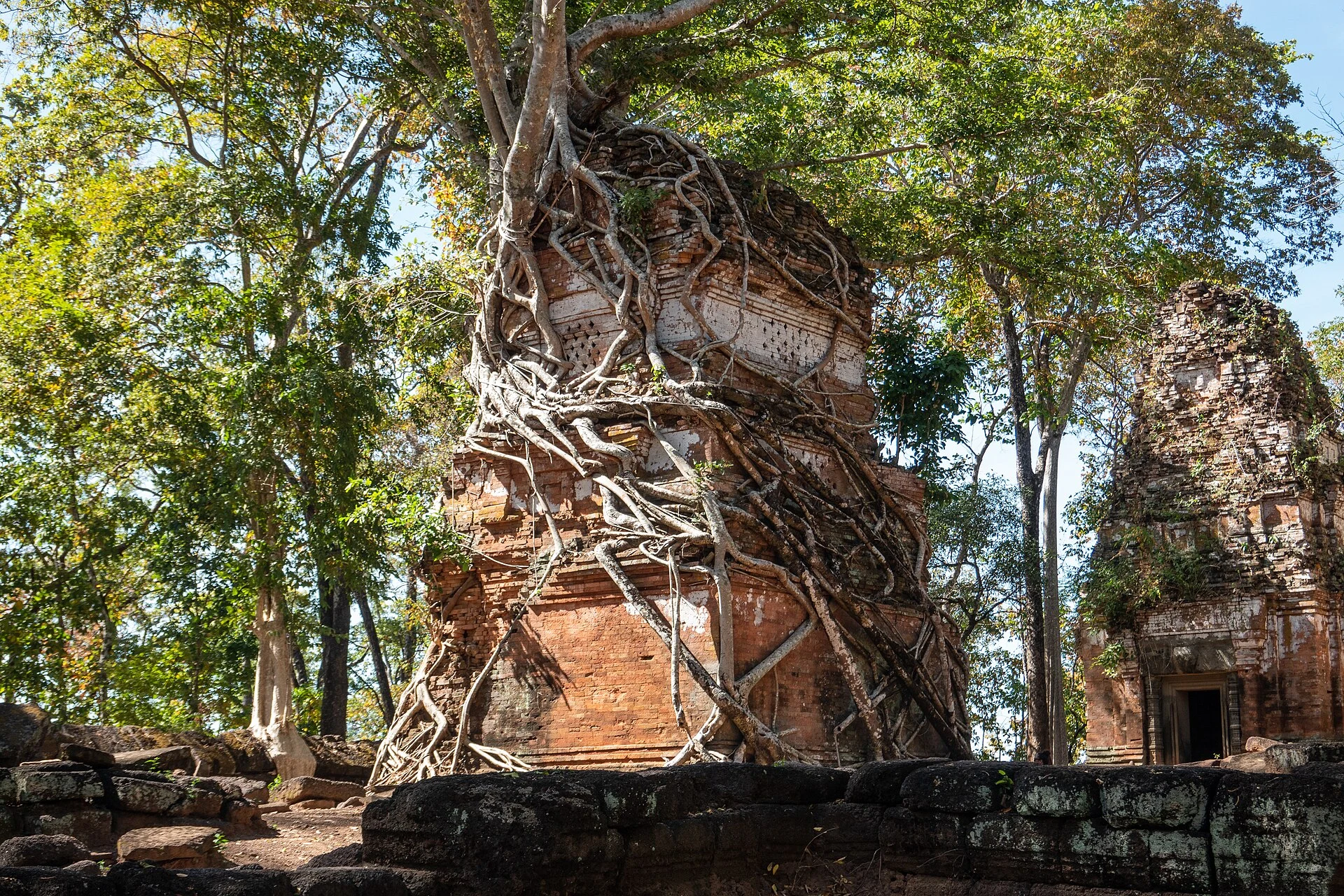
A short, coherent route through a dispersed site
Plan the day on two scales. The first is Prasat Thom, the monumental core and the best starting point. Here, Prasat Kraham, Prasat Ruom, the moat, Prasat Prang and the terrace of the lingas follow one another. Do not rush: this group helps you understand the spatial sequence that makes Koh Ker a former capital rather than a collection of ruins.
The second scale is to choose two or three groups outside the core, keeping the vehicle nearby. Prasat Pram and Prasat Neang Khmau are good reference points for changing perspective and seeing how the temples are distributed across the landscape. The managing authority also documents other sanctuaries around Rahal and along the city’s former axes; this is a reason to leave some flexibility rather than set a rigid schedule.
The management record describes a circuit linking the principal temples by an internal road. Therefore, walking works for each group, but it does not replace transport between them. Before setting out, agree with your driver which stops matter most and how long you will wait at each one.
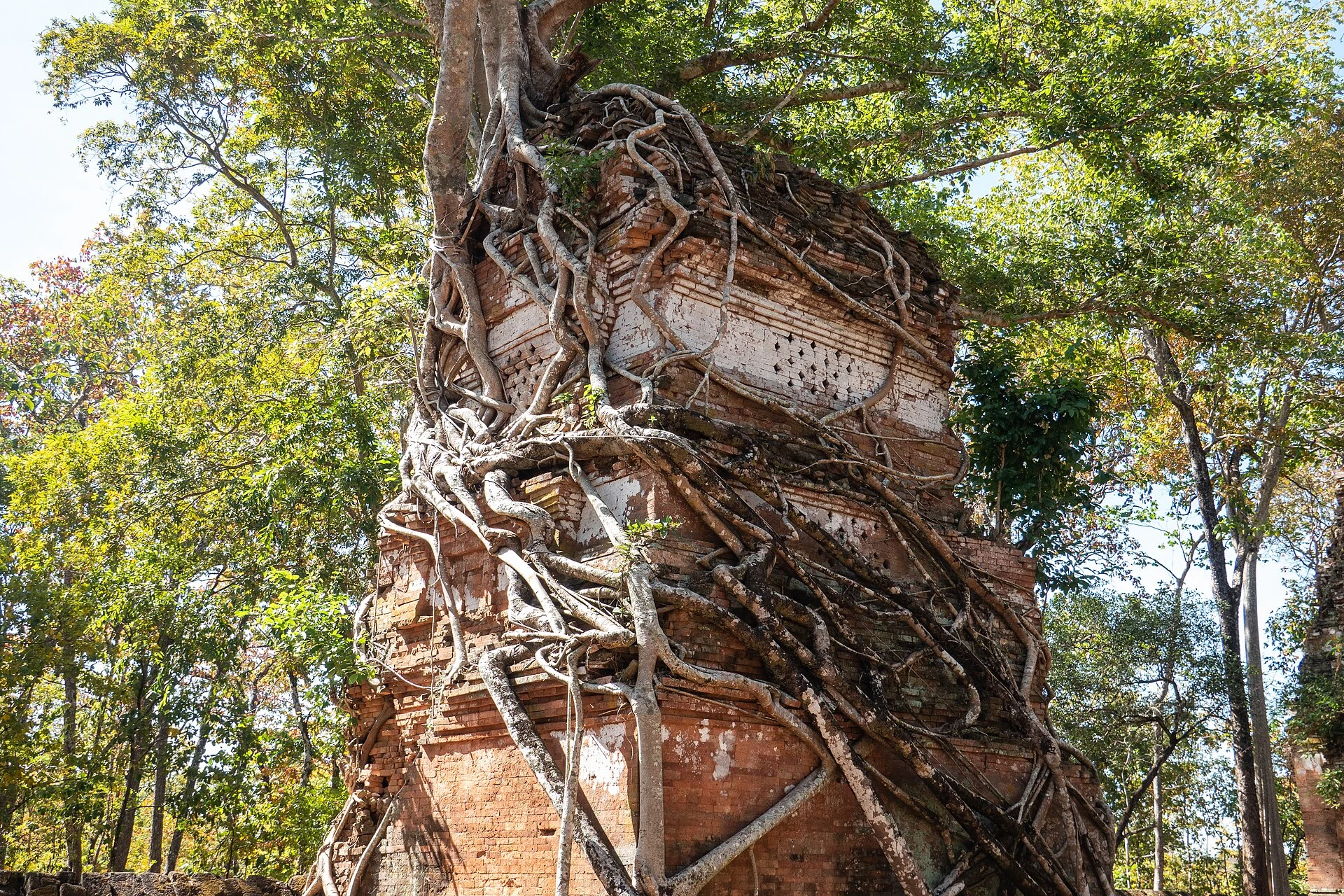
Getting there from Siem Reap or connecting from the north
Koh Ker lies in Preah Vihear Province, northeast of Angkor. Heritage documentation identifies access from Siem Reap via Beng Mealea and National Roads 6 and 64; it also describes an approach from Phnom Penh via Roads 6, 62 and 64. This is useful for understanding the geography, but it does not replace checking road conditions for the exact date of your trip.
For travellers staying in Siem Reap, Koh Ker works best as a day trip devoted almost entirely to the site. Adding Beng Mealea can make sense only if you accept less time at each place and confirm the route, tickets and access conditions in advance. If Koh Ker is the main objective, giving it the full day allows you to reach the outer groups without turning them into rushed minute-long stops.
A route without a private car should not be promised: the site’s dispersed layout makes it important to have a hired vehicle, an organised excursion or an equivalent solution. Bring water, sun protection and footwear suitable for uneven ground; here, the logistics of distance matter more than they do in a compact urban site.
Tickets and opening hours: use the more cautious information
As of 17 September 2026, the official ticket operator lists a US$15 one-day pass for Koh Ker, valid for one day, with more than ten accessible temples and general hours stated as 6:00 to 18:30. However, its specific Prasat Thom listing gives opening hours of 7:00 to 18:30. Given the discrepancy, plan your arrival using 7:00 as the cautious reference until you receive official confirmation.
These prices, hours, purchasing methods, open access points and possible closures can change. Check them the day before and do not base a transport connection or combined itinerary on an outdated schedule. It is also worth asking which sectors are open that day before deciding how much time to devote to the outlying temples.
Koh Ker is protected and managed as cultural heritage. Follow the authorised routes, do not handle stones or objects, and do not turn sculptures, inscriptions or fragments into photographic props. The site’s recent history includes looting and the recovery of works: protecting the context matters as much as viewing the monuments.
The practical choice: a focused day trip or an overnight stay with more flexibility
Choose a return day trip if your priority is to understand Prasat Thom, Rahal and a short selection of outlying temples. It is a good option for a trip centred on Siem Reap, provided you accept that the visit depends on road conditions, your vehicle and the length of each stop.
Consider spending a night in the area if you want a less compressed schedule, plan to stop at more groups or intend to continue towards other northern destinations. The advantage is not a promise of solitude or a better experience, but greater room to adapt to changes in access, heat or the group’s pace.
In either case, approach Koh Ker with a precise expectation: it does not offer the monumental concentration of a single enclosure, but rather the more analytical pleasure of reconstructing a city through distances, water, architecture and scattered remains.
References and checks before setting out
Check before travelling: tickets, opening hours, visitor-accessible sectors and road conditions through these official sources:
- Angkor Enterprise, “Available Tickets” and “Prasat Thom Complex” listing: advertised pass, hours and number of temples.
- UNESCO, Koh Ker: Archaeological Site of Ancient Lingapura or Chok Gargyar: chronology, heritage values, extent and the site’s protection framework.
- National Authority for Preah Vihear, Koh Ker archaeological section: groups and site features managed by the responsible authority.
- Ministry of Tourism of Cambodia, Koh Ker Temple listing: general description and provincial location.
References consulted during editorial review. Times, requirements and advisories may change: always confirm with the official source.
- https://whc.unesco.org/en/list/1667 whc.unesco.org
- https://whc.unesco.org/document/186494 whc.unesco.org
- https://whc.unesco.org/en/statesparties/kh whc.unesco.org
- https://whc.unesco.org/document/205732 whc.unesco.org
- https://tourismcambodia.org/public/attractions/koh-ker-temple-1550046130 tourismcambodia.org
- https://apsaraauthority.gov.kh/wp-content/uploads/2021/08/APSARA-Authority_Angkor_Temple_Angkor-Heritage-Management-Framework-October-2013.pdf apsaraauthority.gov.kh
- https://whc.unesco.org/en/list/1667/documents/ whc.unesco.org
- https://whc.unesco.org/document/222806 whc.unesco.org
- Camboya WikidataCC0 1.0 Wikidata · Q424
- Cámboya WikidataCC0 1.0 Wikidata · Q5202336
- Cambodia World Countries — mledozeODbL 1.0 World countries dataset by mledoze and contributors · ODbL 1.0
- Cambodia World Bank Open DataCC BY 4.0 World Bank
- Cambodia DBpediaCC BY-SA 3.0 DBpedia
- PAISAJES DE AGUA: EL CASO DE LA COMUNIDAD DE CHONG KNEASLAGO TONLE SAP CAMBOYA OpenAlexCC0 1.0 OpenAlex